Harris and Me
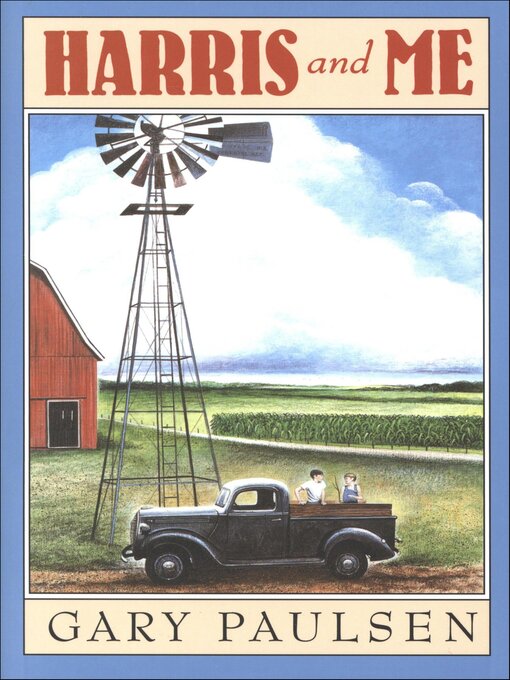
Author: Gary Paulsen
Genre: Junior Fiction, Slice of Life
Published: 1993
Rating: ★★★★☆
Famous for his Hatchet series of young-adult novels, Gary Paulsen’s Harris and Me, written in 1993, tells a pseudo-autobiographical story of an 11-year-old boy who leaves his parents’ custody to be with his cousin’s family on a rural farm. There the boy discovers a new way of life, meets new people, and forms connections and bonds that would bring him the love and comfort he unknowingly needed. Each chapter tells a different story as we see the boy slowly growing accustomed to living with farm animals, to the pleasures of outdoor playtime, to the agony of work life, and to the social customs that the rural world offers. But ultimately, it is his cousin Harris who makes the boy feel welcome, who helps the boy understand that home isn’t where your parents are – but where the people who love you are.
What I love most about this book is that it breaks boyhood down to its essence. Paulsen intimately recalls these memories for us, as if we were a young child sitting down for story time. Unfamiliar sights and sounds, new sensations, developing feelings and emotions are transcribed for us. Paulsen reframes from hiding or embellishing the nature of boys and boyhood – instead, he opts to lay it all bare for us. Those moments of fun and play, the awkwardness of growing up, the embarrassing memories we’d rather forget. All of it is presented much like a child’s diary, very imaginative, but still based in reality.
The contrast between the boy and his cousin couldn’t be more different. Upon first meeting Harris, our protagonist describes him as a boy who was:
“Blond-haired bleached white by the sun – face perpetually sunburned and red with a peeling nose, freckles sprinkled like brown pepper over everything… He was wearing a set of patched bib overalls. No shirt, no shoes – just freckles and the bibs, which were so large he seemed to move inside them.”
However, Harris makes the first move to initiate his cousin into life on the farm. Whether knowingly or unknowingly, Harris adopts the role of a brother, playing a responsible role when needed (such as showing the boy how to properly do chores) and a playful role (which he takes at almost any given opportunity). Taking care of the pigs becomes a game of war, the chore of catching mice becomes a friendly competition, and riding horses becomes a game of “Cowboy and Indian.”
“It sometimes seemed all we did was play that summer – and to be sure, most of what Harris and I accomplished centered on playing. Or trying to play.”
It’s here that we see the boy’s transformation from an outsider to one with the family. The boy doesn’t question the rural way of life, he isn’t scandalized by anything, he doesn’t hesitate to try new things. This is best demonstrated when Harris and the boy, after finishing their daily chores, strip their clothes off and run naked into the river to play.
“We were lying nude on the bank of the river, the sun cooking us dry. I kept looking up toward the house and covering myself with my hand – we were in plain view – but Harris didn’t seem to care. I lay back and watched the clouds for a moment and wondered how it could be that I was living here now and had been living somewhere else before, and why I didn’t seem to remember so much of the other place I had lived…”
I won’t spoil the ending of this book, as what happens next is something we can infer through Paulsen’s other literary work. That said, a valuable insight we can gain from this is what home means to boys and what boys need most. Boys need a place to be free, free from the dysfunction and pain caused by those who only bring suffering and heartache. Boys need friends, other boys who will share in their games, their interests, their secrets – friends who will desire to spend time with them and want to develop a genuine relationship. Boys need love, a love that will demonstrate mutual understanding, vulnerability, and compassion.
I highly recommend Paulsen’s book to anyone that just wants to relive those innocent moments of childhood, to recapture the whimsical, nostalgic charm that they haven’t experienced in a long time. There may be some parts of the story that seem a bit too obscure or lost in translation, as the book takes place in the 1950’s. But putting those minor details aside I do think the book is definitely worth checking out!