Skinny-Dipping At Monster Lake
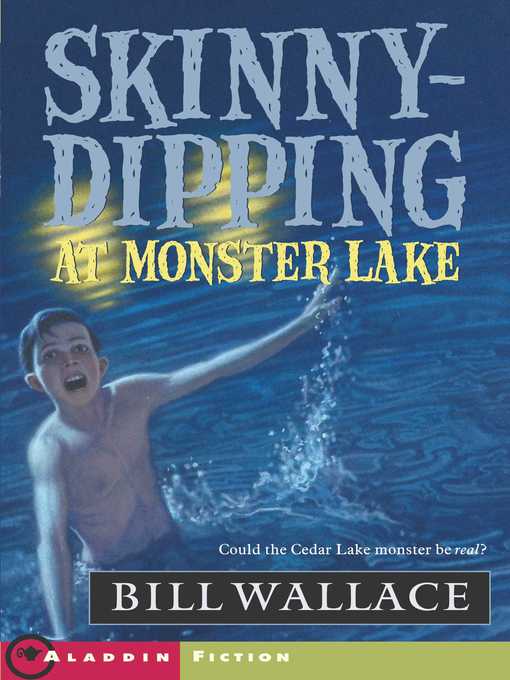
Author: Bill Wallace
Genre: Slice of Life, Junior Fiction
Published: 2003
Rating: ★★★☆☆
At the outset, Skinny-Dipping At Monster Lake doesn’t offer much. On the surface, it’s just an average middle-grade novel by children’s writer Bill Wallace (well-known for A Dog Called Kitty written in 1980). The story revolves around Kent and his group of friends as they spend their last days of summer riding horses, playing games, and of course, swimming. However, rumors spread that there’s a monster in Cedar Lake when strange things start to happen in the water at night. It’s up to the boys to investigate and find out what’s really going on!
Written in 2003, the book takes a contemporary approach to a nostalgic boyhood pastime that’s been long forgotten. The group of 12-year-olds, believing they have everything set up for an all-night fishing trip – are ready to start heading towards the bank poles when one of the boys inquires where their boat is:
“We don’t have a boat. No sense in worrying about bank poles now. We’ll bait ’em up right before dark.”
“But how are we going to put the bait on them without a boat?” Jordan asked.
Ted’s frown curled to a sly smile. “We just wade out and put it on.”
“But none of us brought a bathing suit,” Pepper protested.
“So?” Ted shrugged.
Mouths gaping open, the whole bunch of us turned to glare at him.
“You mean . . .”
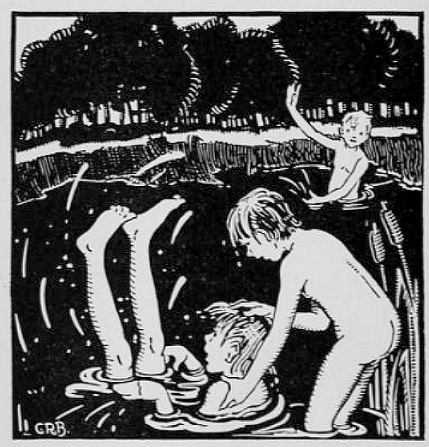
illustration by Corinne Ringel Bailey
Ted nodded. “After dark nobody can see us. We’re not close to anyone’s house. And we’re just a bunch of guys. Who needs a bathing suit?”
Thus begins the boys’ first experience nightswimming as nature had originally intended. Kent being naked with his friend Ted in the water brings to mind the sudden vulnerability of his own body. However, Kent can’t decide how to feel about the sensation – how scared is he? Is he only frightened because it’s night and he’s never done anything like this before?
Kent’s friend Daniel asks him afterwards that same night what it felt like. Lying to himself, Kent suggests that the experience was nothing to be afraid of. The night would turn to day, the boys finding themselves exhausted from their trials. With a campfire still roaring, Kent takes notice and acknowledges that boys “know how to put a campfire out,” describing it as a natural instinct.
It’s one of those things that nobody – not even your dad or the older guys – have to tell you.
You just know.
While skinnydipping might have been an unusual activity for these boys of the modern, 21st century, they aren’t strangers to nature, to their own bodies, or to each other’s bodies. Forming a circle, the boys put out the fire the only way they know how, while Chet and Daniel lowered their defenses and started what Kent describes as a “swordfight” with their streams.
These boys, although American, are not Tom Sawyer and Huckleberry Finn, boys who could readily strip off their clothing and jump naked into the river without a care. Each boy in this book has an unusual sense of what is and isn’t modest, and as a consequence - shame is attached to these same sentiments. One could argue that, even in a boy’s only environment, modernity has made them almost too modest, with their natural tendency being to hide their sensitive regions or to clothe themselves for fear of being seen naked. The ultimate question this book raises for me is this: What is there to hide? The friend group in this book have known each other for a long time and are almost always seen by themselves – with no parents or girls present to put a barrier on their behavior or emotional vulnerability.
So what’s stopping the boys from embracing the freedom that comes with an environment where everyone else looks like you, where everyone else shares your body? Isn't this something Kent recognizes when he and his friends put out the campfire? What prohibits these boys from embracing each other’s nakedness and having fun? Throughout the book Kent refers to his friend group as “the guys,” likely as a means to feel more mature or older than he actually is. In a later chapter, the confirmation that the modern culture has either repressed or made nude swimming forbidden (or any casual nudity for that matter) comes when Kent expresses a sense of relief when him and his friends come back to Lake Cedar, now wearing their swimming trunks.
I long for a times past when the body was without controversy. And although this book still captures a small essence of the innocence and purity of American boyhood, I can’t help but feel that there is a barrier or wall separating these boys from expressing genuine intimate moments. This isn’t to say nakedness is absolutely essential, but to be free from all restraints – from emotional barriers to societal taboos, all the way to modern customs and norms, what better way to express that than being naked with your friends?